
PLATFORM
One Core. Seven capabilities.
Digital Schéma is not a collection of unrelated websites and add-ons. It is a controlled platform architecture designed so identity, users, records and modules can work together.
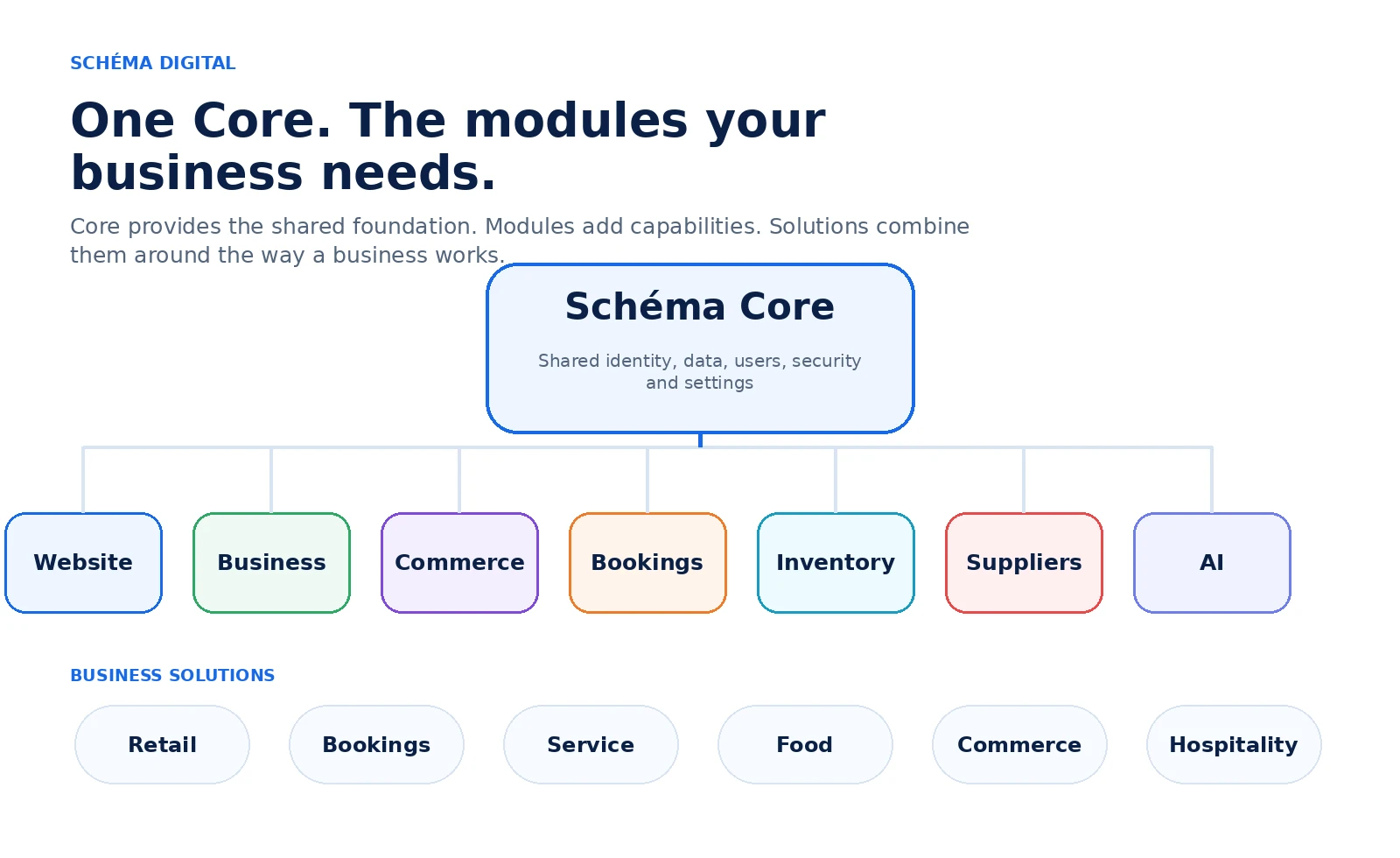
SCHÉMA CORE
The shared foundation behind every Schéma system.
Core keeps the business identity, users, settings, records, security and activated capabilities in one controlled foundation. It is configured as part of the first useful solution — not sold as empty software.
01
Identity & appearance
Shared business details, branding, language and presentation settings.
02
Users, roles & permissions
Give each person access only to the work and data they should manage.
03
Shared records & data
Customers, products, orders, bookings and jobs can be reused across connected modules instead of duplicated.
04
Security, updates & continuity
A common update, security and backup boundary protects the whole installed system.
05
Module & licence activation
Only purchased capabilities are activated; more can be added without rebuilding the business from zero.
06
Import, validation & reporting
Structured onboarding checks data before it enters the operational system and records what was imported.
CUSTOMER-FACING CAPABILITIES
Websites, Commerce, Retail & POS, Inventory, Customers, Operations and Schéma AI.
These are the capability families the customer sees. Each card also explains the technical components underneath, without forcing the buyer to learn our plugin names.
01
Websites
Be found, understood and contacted.
The customer-facing presence: multilingual pages, information, forms, enquiries, listings and actions.
- Multilingual pages
- Forms & enquiries
- Products, services or listings
- Google-ready structure
- Customer actions
- Connected front end
Built from
Website
02
Commerce
Products, checkout, payments, orders and delivery.
The online sales route from catalogue and checkout to payment, order, fulfilment and customer record.
- Product catalogue
- Cart & checkout
- Online payments
- Orders & fulfilment
- Click & Collect
- B2B / wholesale routes
Built from
Commerce
03
Retail & POS
Physical sales, returns, customer history and fiscal/POS integration.
The in-store selling layer, coordinated with customers, products, stock and the approved fiscal or payment route.
- In-store sales
- Discounts & returns
- Customer history
- Omnichannel stock
- Store workflows
- POS / fiscal provider route
Built from
Commerce + Business + POS/fiscal integrations
04
Inventory
Stock, variants, barcodes, purchasing and restock alerts.
One controlled product and stock master, including suppliers and purchasing where the workflow needs them.
- Products & variants
- Barcodes & labels
- Stocktakes
- Transfers & locations
- Low-stock alerts
- Suppliers & purchase orders
Built from
Inventory + Suppliers
05
Customers
CRM, loyalty, history, segmentation and re-engagement.
One customer identity and history shared by the journeys that need it, rather than separate lists in separate tools.
- Profiles & history
- CRM & segmentation
- Loyalty & retention
- Consent & preferences
- Re-engagement routes
- Customer reporting
Built from
Business / CRM
06
Operations
Bookings, jobs, staff workflows, tasks and reporting.
The daily work layer for appointments, jobs, resources, service history, staff actions, follow-ups and owner visibility.
- Bookings & resources
- Jobs, quotes & follow-ups
- Staff tasks & permissions
- Waiting lists & reminders
- Service history
- Owner reporting
Built from
Business + Bookings
07
Schéma AI
Forecasting, anomaly detection, recommendations and document reading.
An intelligence layer activated only where the relevant operational data, workflow and human review already exist.
- Sales forecasting
- Customer segmentation
- Anomaly detection
- Document extraction
- Recommendations
- Owner daily briefing
Built from
AI + active operational modules
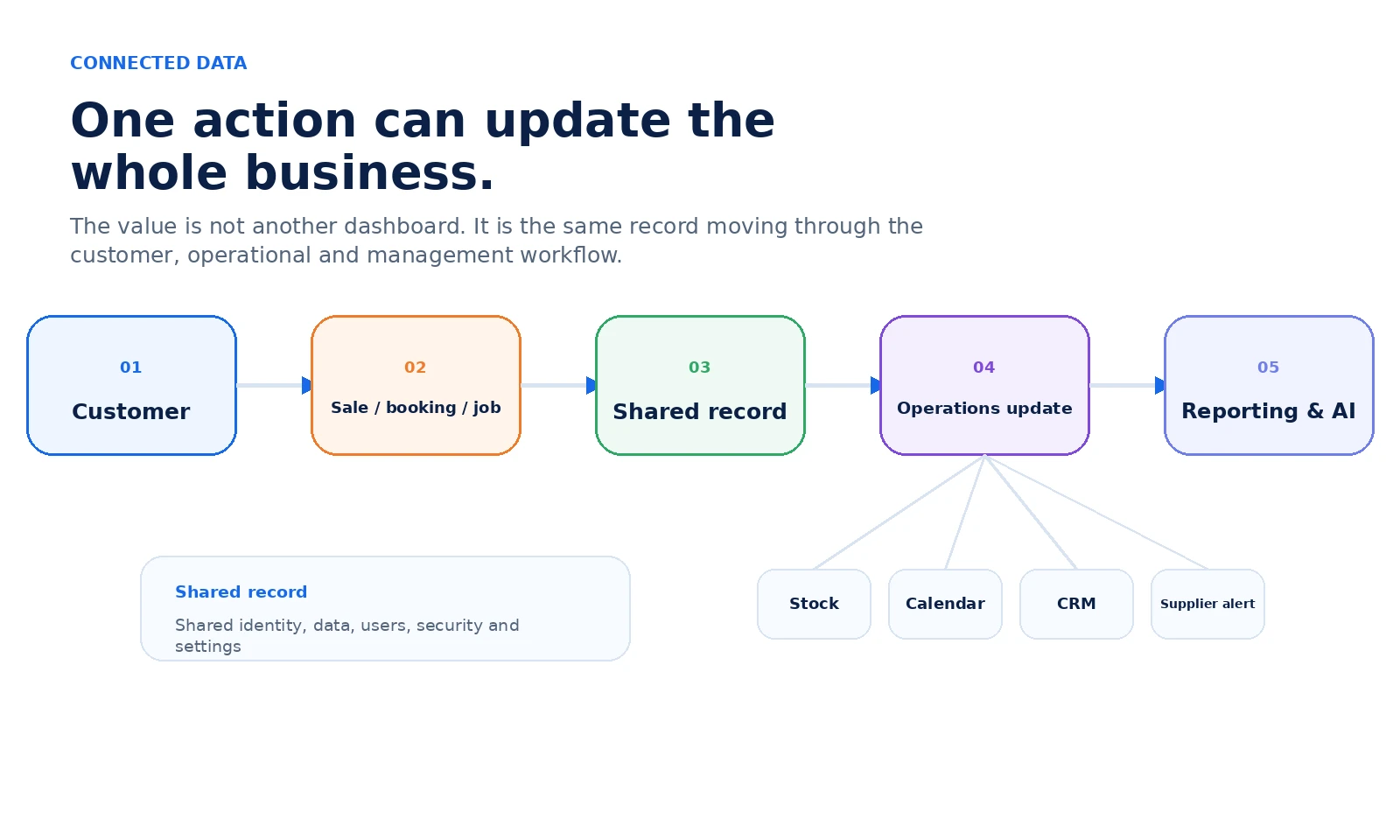
CONNECTED DATA
Shared records replace repeated manual reconciliation.
The same customer, product, booking, order or job can be used by the modules that need it. That is the point of the Core.
INTEGRATIONS
External providers connect around the platform — they are not hidden inside it.
Payments, fiscal services, messaging, hardware and external channels have their own accounts, contracts and charges. We specify those boundaries before implementation.
01
POS & fiscal route
Connected through the approved provider and project-specific legal route; not represented as Schéma replacing regulated fiscal services.
02
Payments
Merchant accounts, gateway charges, card processing and refunds remain with the selected payment provider.
03
Messaging
Email, SMS, Viber or other messaging can be connected where the workflow and provider support it; usage charges are separate.
04
Hardware & external systems
Scanners, printers, terminals, channels and external services are specified separately and connected only when technically and commercially appropriate.
SCHÉMA DIGITAL
Build the platform in stages.
Start with the Core and the first module combination that solves a real problem. Add more only when the business is ready.